Bittersweet Victories and AI Cosmology
My book is out! And can be purchased through IngramSpark directly, incidentally. Who knew?
The tragicomedy post-launch feeling is real. Before, when I was still on social media, I could scream into the void under the illusion that someone, somewhere, out there could hear me. That my high school friends and college acquaintances could see my success as if it were etched on the very surface of the moon. Should it then be comforting that I have chosen the terror of reality over the bliss of illusion?
Well… Sure?
But in all seriousness, it is jarring to spend 5 years of your life on something, to pour out your very soul upon it, as if it were a blood offering to some ancient horror, only to be rewarded the prize of two heart emojis in the family group chat. I also, never in a thousand years, would have imagined my brother as my #1 true fan, given our shared traumatic history: divorce, resource scarcity, antagonism, resentment, etc. (We made up post-college. If anything, it is a testament to the power of forgiveness and of the gospel.) But I wouldn’t have it any other way.
I catch myself in this entanglement often. These feelings that stem from a misalignment of the heart. True fulfilment comes in the love of God and his son Jesus. The opportunity to walk by his will to save the world, the prize overall worth pursuing. My worth and value as a human being is untethered from my success as a writer, or my ability to entertain. Nay! My worth and value as a human being originates from the very love that God demonstrated for me in his death upon the cross.
That’s how I should feel at least. But sometimes it’s still difficult to find that line of separation. I blame the MTV.
***
I’ve had some good developments in the building out of my new sci-fi world. One of the strange things about writing where math is involved is that, because I’m not good at it, I’ve been experimenting with AI to run calculations on things like rotation periods, orbital years, goldilocks zones for habitable atmospheres, and genetic adaptations to exoplanetary physics. While I don’t have to do this, I’ve felt more convicted that my setting needs to be at least somewhat plausible. There was a scene I was setting up in a plot outline, for example, where a character looked out over a wide vista and saw a city in the distance. Given the circumference of the planet, how far could the observer see from the overlook? How high would the overlook have to be to see the city? Turns outs, with a circumference of X, the max arc distance is roughly 250km, but the city itself is about 500km away. All this to say: my scenario wouldn’t be possible.
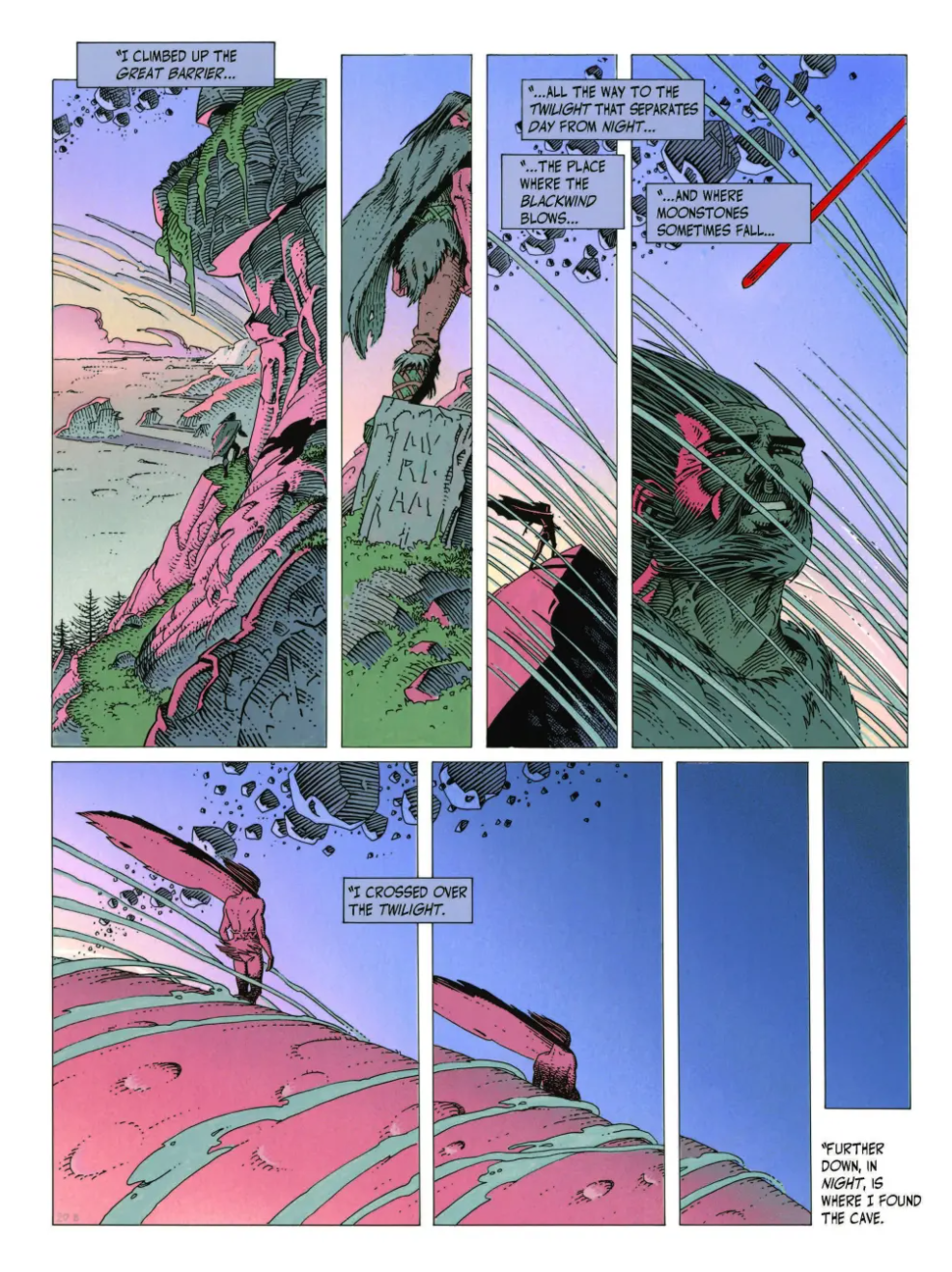
French artist Caza went to great lengths to build out his vision of a post apocalyptic earth in Arkadi And the Lost Titan, featuring a hellish future where the earth’s rotation eventually stopped altogether. In the book’s recent imprint, which I picked up earlier this year, there’s detailed topographical maps explaining in surprising detail the geography of where the story takes place. Caza took great pains to render a “realistic” approach to how this new environment would affect his narrative and the characters that populated it. French existentialism, strange narrative shifts, and a feverish surrealistic finale notwithstanding, it works somehow.
***
If you haven’t had a chance to pick up my book though check it out here. If you do buy it on Amazon, please leave a review to let me know what you thought about it.
Best,
Stuart
