Health Influencing is the New Gnosticism
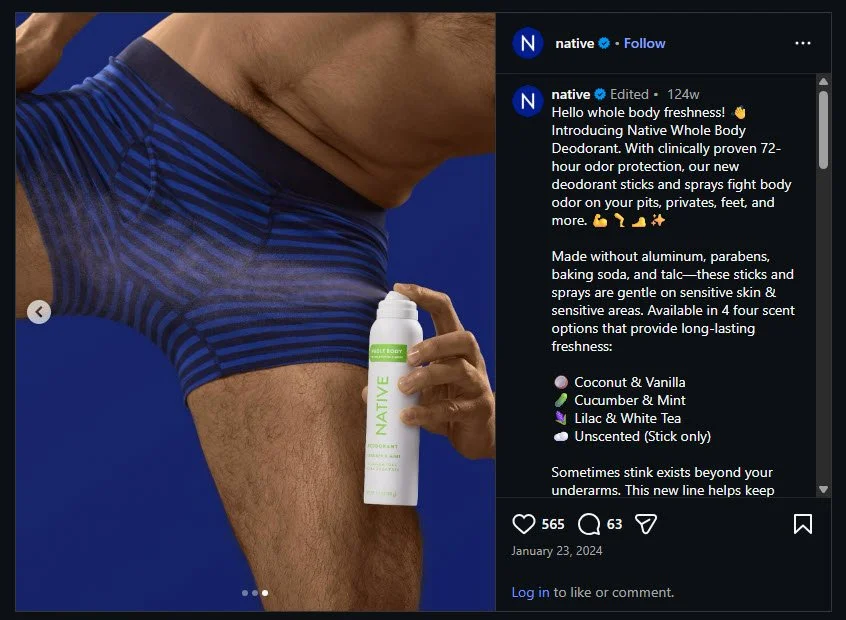
YouTube used to show me ads for products made by Native, which promoted things like “all body” deodorant. The most prominent spokeswoman, a sassy comedian in a centaur costume (“Scentaur” actually) conveyed the aspect of a mythical creature, appearing before mortals to tell them they all needed to get clean. (Or else?) Similar ads for men also ran (although I only now just saw one when googling it), but the pitch lacked a certain charisma of a centaur woman, wildly, freely convulsing in some Dionysian ecstasy. Across ads both targeting men and women, the imagery was primarily a romanticized greco-roman setting featuring serene meadows and abstracted, Olympian enclaves to the gods.

The overall pitch between the two were surprisingly blunt, deploying purposefully vague language, but anyone could clearly divine their meaning: “your vagina/scrotum/anus stink, but with Native, we got you covered!”
Commercials like these are nothing new. I remember seeing commercials for “poo pourri” when I was in college, which used an oily substrate to lock in the smell of excrement, keeping your family members and guests alike from having to experience the horror of whatever you just ate. All seem to intimate the idea that the body is gross and dirty, and that something should be done about it.
Before deodorant, perfume served this purpose. For thousands of years, in some other form or another, humans have been devising a variety of ways to mask their own filthiness. Scents derived from natural ingredients were distilled and suspended in essential oils or fixatives to adhere to the skin. Animal derived fixatives include sperm whale vomit (not actually, but basically), perineal glands of the civet cat, and the castor sacs on beavers (also, basically, located next to the genitals). While synthetic alternatives appear to exist, general consensus is that the animal derivatives are far superior. All allowed perfume to bond better with the wearer’s skin, that they may momentarily smell pleasant before going back out into the world, which for the majority of human history had lacked things like sewage management and waste removal.
The common theme emerges once more: “The body is gross and interacts with gross things. Who’s got a mint?”
Targeted body odor ads in my YouTube feed aside, there are movements to “purify” the body via other means than perfume. There’s the whole Wellness industry, made infamous by companies like Goop and health influencers like Liver King. Each company manufactures a problem and then conveniently offers a solution in the form of bone broth or jade vagina eggs. I saw this as well in my short stint working at a health foods store in Santa Barbara County, where customers would spend hundreds of dollars on vitamin supplements to cure their cancer or offset the need to rely on western medicine for routine wellness checkups. Underneath each person enthralled by the Wellness phenomenon was a deeper paranoia, that the world was lying to them in some form of another, that they themselves had carved out their own personalized bubble of sanity. They had “secret” knowledge that superseded the conventional wisdom of those around them.
Where I’m going with this is the parallel between our current pseudo-spiritual, mind and body fads is a very old idea at work call Gnosticism.
You all have Google so I won’t go too deeply into it, but the TL;DR of Gnosticism is, “world=bad; spirit=good.” And this ancient mystery religion had lots of interactions with culture and the philosophy of antiquity. In Platonism, one could build, touch, interact with a chair, but somewhere in a higher reality was an ultimate “form” of a chair, and it was one’s goal to grapple with and grow closer in understanding of the “form” over the physical object. There was, likewise, the idea of a physical body, but a higher, imperishable soul that transcended the body. Gnosticism took this idea and extrapolated from it the conclusion that the physical world was fundamentally misleading, created even by an “evil god” called the Demiurge, to keep us from realizing the much greater, and benevolent, supreme deity that existed beyond the physical world. Things like introspection, meditation, communing with spirits, possessing “hidden knowledge” were like catnip to Gnostics. Marcionism, a Christian heresy founded by Marcion of Sinope in the mid 2nd century, suggested that the God of the Old Testament (Yahweh) was the Demiurge and that Jesus had revealed the true, supreme creator. (Jesus by this model wasn’t even human, but an immaterial imitation that, consequently, never died and rose again.) Basically, Gnosticism with a Christian facelift.

That’s Marcion of Sinope. Don’t be like Marcion of Sinope.
The problem that Gnostic thought introduces into our lives is the fundamental erosion of trust in the physical world. While there may be some fundamental Truth out there, it is unknowable or locked behind metaphysical experiences that one must understand to comprehend them. According to Tom Holland in his book Dominion, it was Christian thinkers like Thomas Aquinas that leaned on the physicality of the resurrected Jesus to give credibility to to created world. Likewise Jesus’ eventual promise of return to restore the world to its intended state suggested a continuity between this world and the one to come. Therefore, the work of scientists, doctors, mathematicians, and other academics became a worthy pursuit to better realize our very intelligible universe. Wellness influencers that undermine vaccine research of flat earthers that believe the sun revolves around the earth are not just irritating, but undermine reality itself.
Another dimension to this might also be the sexual revolution, which proceeds along this same line of thinking, although I wouldn’t say it’s due to some “sinister agenda”. We are, after all, products of our age. If we are provided a framework that values self-discovery and the preeminence of “authenticity”, both subjective values, the ultimate conclusions to what those things are will vary. Some will feel most satisfied in a certain gender expression or sexual identity, because that’s what’s authentic to them. Again, as a Christian, I’m operating out of my paradigm that there is a “capital-T-truth” available to us in the form of Jesus, the true referent to humanity, and that there is objective historicity to the person of Jesus that gives us confidence in his formulation of the world and how it must be ordered. Others would disagree, and that’s fine.

Yet another dimension to this, similar to the previous example, is the Transhumanism movement, popularly imagined in the playground of Cyberpunk science fiction. They body is imperfect, incomplete. It requires augmentation to bring it to it’s true potential. Although the concern is no longer one attaining the secret knowledge of the true nature of a spiritual-cosmic reality, the aforementioned “true potential” is subjective to each individual’s own source of "Truth” and it involves Kiroshi optics and robot legs.
I could go on.
Suffice to say, I would be skeptical to anyone telling you that they have the true nature of reality figured out, and thus needs to sell you something to achieve it. And although the cliche of televangelists selling their services to “bring people to Jesus” is, sadly, well established in the common culture of the world, orthodoxy teaches us that he bought the cure to the problem of one’s separation from God, and is now giving it all away for free in self giving love. But when Alex Jones says that you need his branded testosterone booster so the gay frog water, that the illuminati put there to make us less antisemitic, can no longer turn you gay, I would be rightly skeptical.
SW
