Gear Acquisition Syndrome is a fondly lauded term in the guitarist community. The need to purchase thousands of dollars of professional equipment, all in pursuit of a mythical “tone” that is—practically speaking—unusable in a mix, is an impulse all too common to me. And with the advent of social media, the temptation has only increased. For example, Ibanez recently announced a collaboration with “Dragonball Z” and not only did I want to buy one, sight unseen, but I felt wholly justified to sell one of my favorite guitars to get it. Seriously, look at this thing:
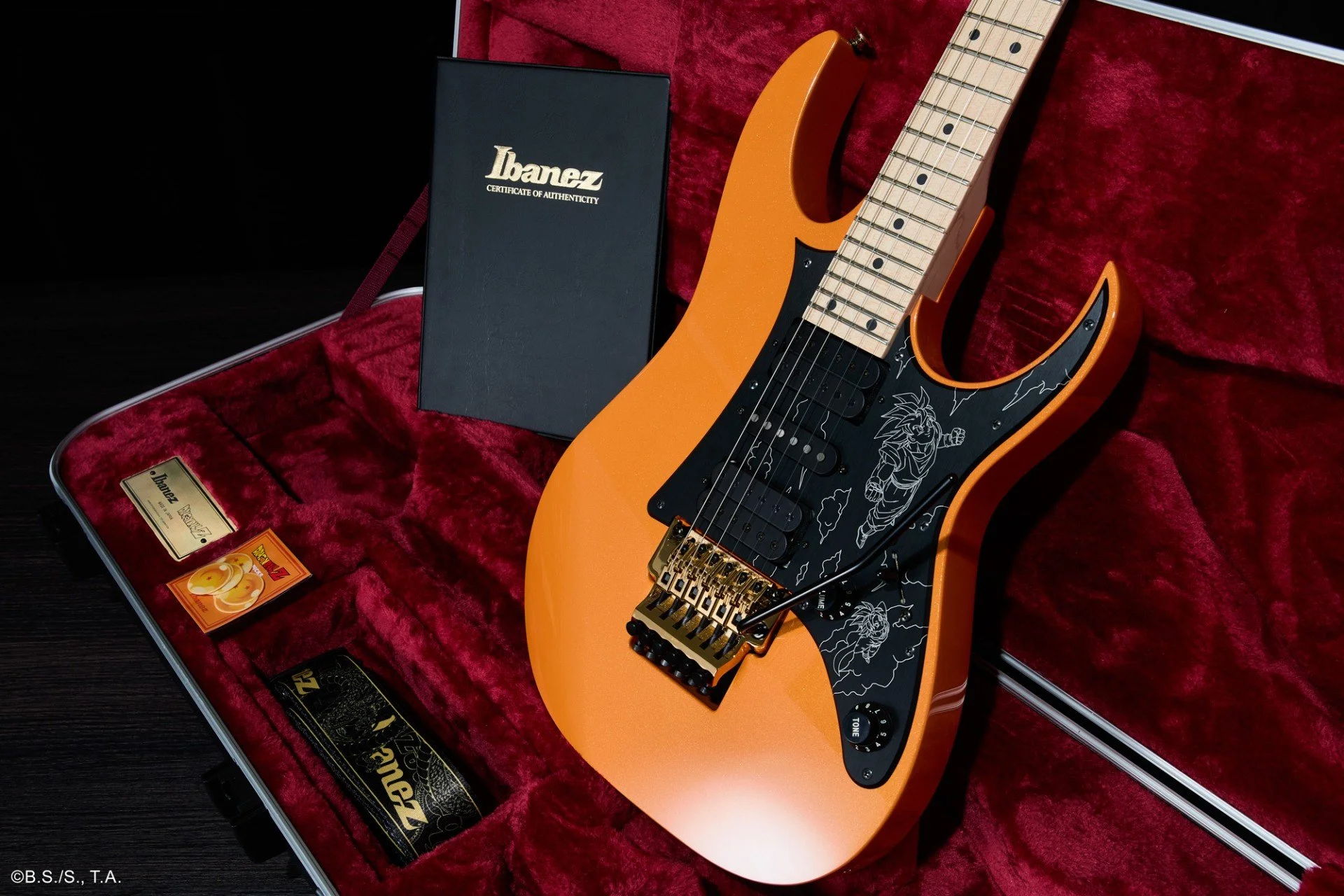
I’m betting it will be something stupid, like $4,000. But a made-in-Japan Goku themed guitar? Just… Amazing.
When buying a guitar, I consider a few different things so that I won’t accrue gear that will just sit around and do nothing. Because the guitar is a tool for making various sonic textures, I mostly look at the scale length, neck construction style, pickup configuration, wood profile, and ergonomics when deciding on a new axe. For example, the above I really want because I don’t have any guitars yet that have a Floyd-rose adjacent bridge. (This one uses a Gotoh Double Locking Tremolo, I think…) Additionally, one day I might get a guitar with neck-through construction, because I’ve always wanted a guitar where the neck literally spans the length of the body itself. Things like that drive my decision making and force me to consider and weight different types of equipment.
I feel blessed to have been born in the late 80s, and to have experienced the wonders of modern music technology. Leaps and bounds in DSP (digital signal processing) and traditional tube amplifier technology have occurred in this space. (The same has happened with cutting-edge home entertainment technology, which now exceeds the quality of most movie theaters.) Despite the latter being comparatively archaic—literally running off of ancient transistors—the advent of the printed circuit board (PCB) allowed amp makers to do all kinds of crazy things. AI has also allowed for amplifiers to be modeled and replicated, which has democratized tone in substantial ways. Have you ever played through a Dumble Overdrive Special amplifier? Probably not. That amp costs $250,000. But you can go online right now and buy the Archetype: John Mayer X plugin and play a flawless, digital recreation of it for around $180.
What’s interesting is that I have played guitar for about 22 years now, and, because of these advances, I am enabled to keep up with it despite everything else going on in my life. Following Grant Morrison’s example, who was both an artist and a writer, I chose writing over guitar playing (and music in general) in college, believing that it wasn’t possible to pursue both with equal intensity. I don’t regret that decision at all, but I’ve wondered what it would have been like to have stick with music and have developed that same kind of sixth-sense when it comes to writing prose. I can stand back and look at a page and see the flow of language and ideas like some futuristic Minority Report cop. I envy my friend Casey who can do something similar: look at a John Williams score and see all of it’s individual components coming together to create something wonderful and beautiful.
Some minor updates:
I will be bringing my daughter out to visit my Dad this year for Thanksgiving, and she’s looking forward to it. I think it will be fun to see the island through her eyes, and I hope my Dad can appreciate that. Continue to pray for him and his cancer diagnosis.
Work also continues on the book. I think I’m finally getting into a groove and feeling out the benefits and limitations of third person limited. After spending the last ten years writing in first person, I could do without something that’s so close to the ground. TPL benefits from a high vantage point, as far as describing the world goes, but still retains some mystery in that the protagonist is forced to guess at what the characters are thinking/feeling. So that should be fun…
Happy writing, folks!
SW
