Concerning Maps
I have successfully, like an 80s action hero escaping an exploding building, exited the prologue and have entered chapter 1 of my new book.
And yet, I seem to be focusing a lot on maps. Why? Most of my Labor Day morning was spent working on a map for the major city in which Act I takes place. There was some backtracking involved. I had to design it’s layout based on previously written content and structure it to serve future additions. In the long run, the extra work will help organize the hypothetical space that I’m working with, but it can be tedious still. I seem to do this with most of the things I write: uncovering old city maps, trawling Google Earth for geographical data, looking at summaries of weather reports to better situate a setting’s climate, whatever I can do to make up for my glaring lack of money/time to travel.
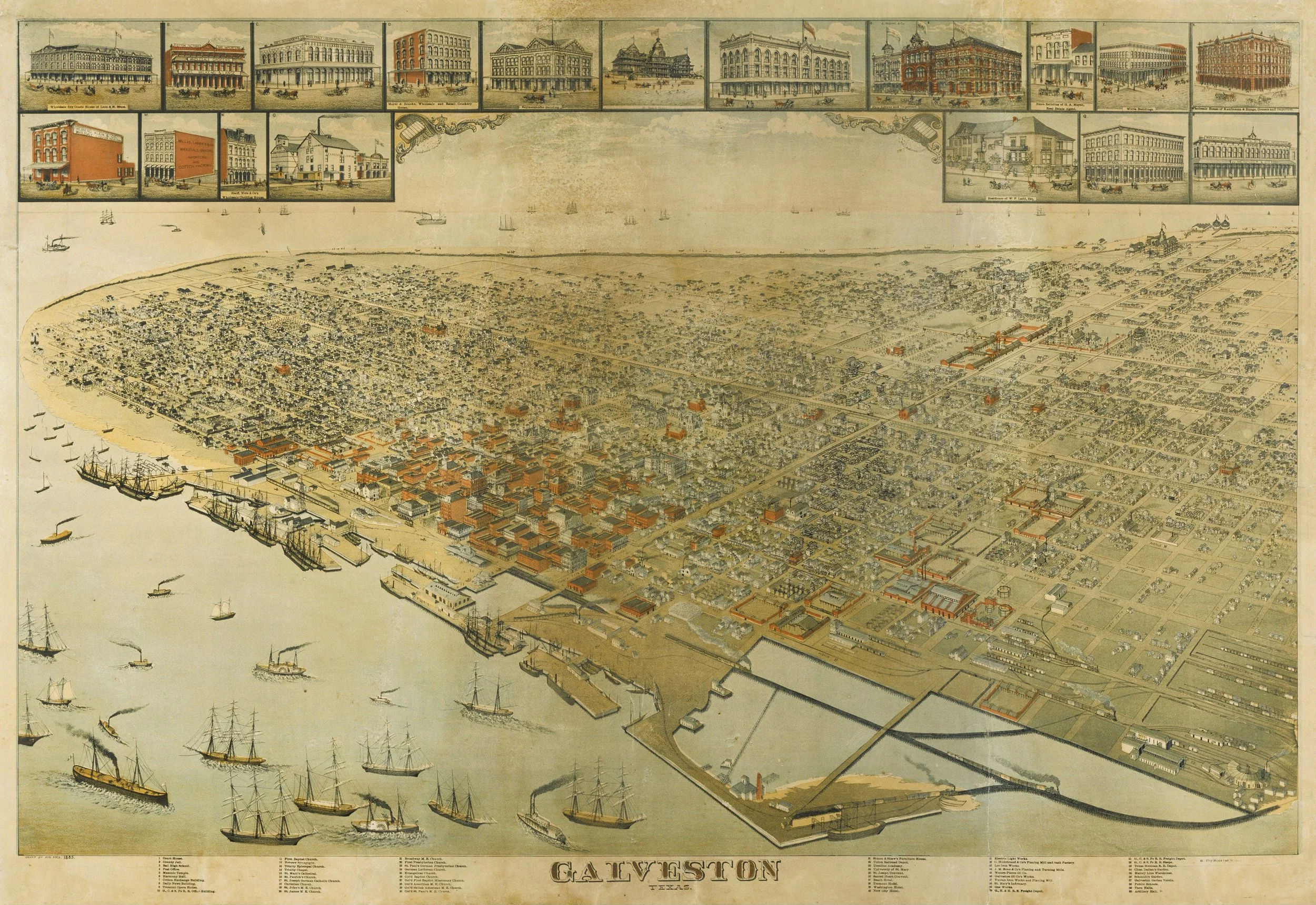
This is the map of Galveston Texas that I used when writing the opening prologue for Tall Men and Other Tales.
Maps establish a sense of defined space inside the mind, which is important because the mind is a crazy place, unrestricted by things like physics or dimensions. (ie. A character couldn’t possibly traverse point A to Point B, so quickly, without the atmosphere catching fire.) They also help to catalogue and arrange locations, continuously layering a settlement with details that establish a foundation of credulity. For example, if a character finds themselves walking down a street with several key plot locations, those details will direct how the scene ultimately gets written. The character might notice something they didn’t see before, or the character might bump into someone from their past. It furthers the illusion that the world being depicted is real and has it’s own continuity. (A building that existed in Book 1 is long destroyed in Book 2—but rebuilt in Book 3—and so on.)
I also find that using a good map (based on real life, or otherwise) can provide inspiration on demand. The other day I was imagining a scene where children receiving an education are moving along a switchback trail to emerge at the top of a plateau. I thought, “What would they encounter along the way? What cultural signposts could I erect to better situate them in their world?” If this book was about Nepal, we could create a similar scene, depicting Buddhists ascending a winding stairway etched in the stone. Along the tight, claustrophobic walls that enclose it, are shrines and motifs carved into the rock. Beyond the path are bottomless chasms that yield to darkness and frost. Details like these can be teased out easily with a good map, something that provides your imagination with volumetrics.
One thing that does bug me about maps, and I’m not entirely sure how to mitigate this, is their opaqueness in fantasy settings. I think maybe this is has to do with the inclination to make these settings feel far off and otherworldly, but the often unintended effect is tedium. “Behold! The Blood Cliffs of Gotholgog’s Shame! Marvel! The Voloruun Realm of Aess and his Minstrels! Consider! The Plain of Holubukuk’s Folly!” This all derives ultimately from Tolkien and his fantasy setting of Middle Earth, but all his goofy ass words had linguistic intent. They were all based off of fictional languages that he painstakingly concocted. I can tell when a writer is just stringing syllables together, and it’s become a pet peeve of mine. Suffice to say, a map’s locations should be intelligible, otherwise the reader is forced to continuously flip between pages to figure out where the fuck everything is happening.
In conclusion, expect an atlas in my next book.
